
Before HDD: what utility evidence should be commissioned at a crossing?
Published on by HR Utilities
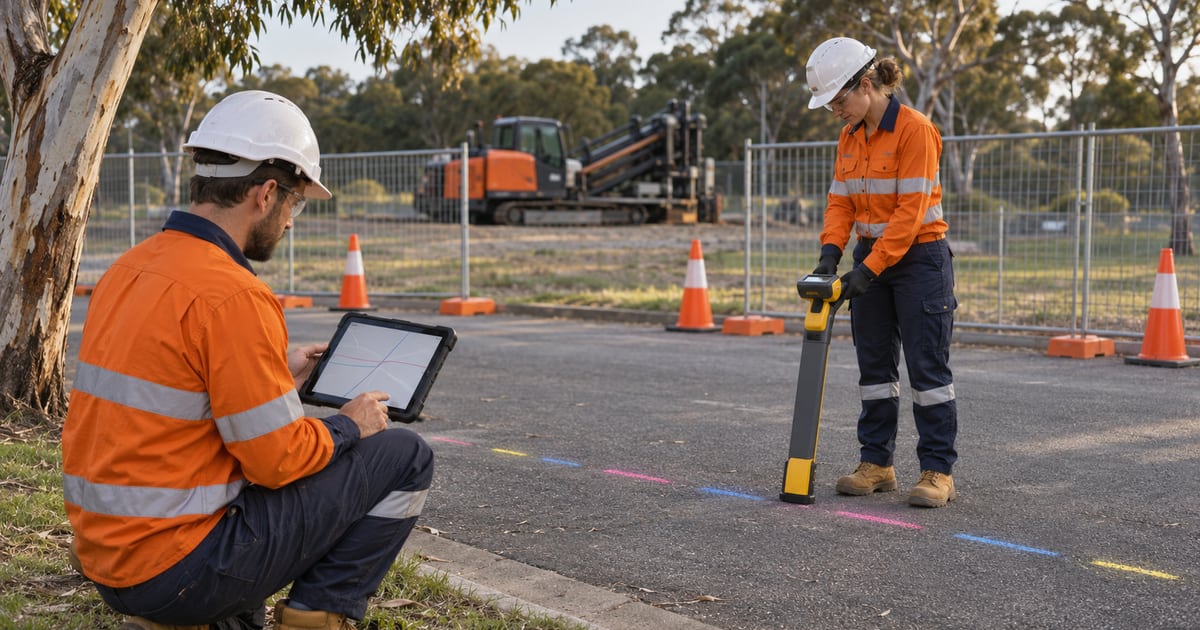
Before booking utility investigation for horizontal directional drilling (HDD), ask the bore designer and drilling contractor which crossing decisions they need to make. Give the investigator the proposed alignment and profile, including entry and exit areas. Commission evidence against that design revision so the receiving team can identify gaps before planning the work.
A surface line and an instrument depth indication leave several questions open. The designer needs to understand what the investigator measured, what they inferred and which asset dimensions remain unknown. The driller also needs the current asset-owner instructions and the project’s agreed response to unresolved crossings.
Agree the investigation boundary with the receiving team
Have the designer identify the space they need assessed for the proposed bore and installation method. Include the pilot path, proposed reaming and installation envelope, launch and reception excavations, and nearby work that may affect existing assets. The designer and contractor must define these requirements for the particular job; a generic buffer from an article cannot do that.
Record the drawing revision and crossing identifiers in the brief. Ask the receiving team what output they need: a plan with surveyed observations, a crossing schedule, or sections tied to the project reference system. Confirm how they will compare the investigation with the bore design.
Commission records and field evidence as separate inputs
Obtain current BYDA responses and the accompanying owner instructions. Check the enquiry area against the proposed work and add private-service information from the site owner. BYDA’s duty-of-care guidance states that owner plans indicate the presence of infrastructure rather than its exact location; they may omit parts of domestic connections. BYDA also calls for a new enquiry if the work scope changes or plan validity expires.
Ask the investigator to record the methods used and the extent examined at each crossing. Request a clear distinction between a surveyed exposed point, a detection-derived position and a route inferred between observations. An investigator should record an expected service they could not resolve, with the limitation and proposed follow-up.
For method selection by pipe material or access, use the existing pipe-location method guide. This crossing brief concerns what the designer and contractor need to receive and review.
Ask which crossings need exposure and measurement
Have the competent project team and asset owner determine the exposure requirements and approved method. Specify the dimensions and levels the receiving designer needs, and ask the surveyor to record which part of the asset they measured. Do not treat one exposed point as proof of the full route or use an instrument depth reading as authority for excavation or drilling.
Melbourne Water’s utility installation guidelines measure clearances from outside pipe or channel surfaces and distinguish installation methods. They also consider soil conditions and asset type, size and age. Those instructions concern Melbourne Water assets. Confirm current project conditions with the owner; the webpage carries a 2017 update date and supplies no universal clearance for other networks.
In Victoria, consult the WorkSafe Victoria and Energy Safe Victoria guide to work near underground services with the asset owner’s instructions and the site-specific safe system of work. For other states, check the relevant regulator. Keep geotechnical assessment and drilling-method design with the competent parties responsible for those disciplines.
Proposed crossing-evidence worksheet
Ask the designer and drilling contractor to review these draft fields before commissioning. Use a separate row for each crossing or unresolved asset.
- Crossing identity: Asset ID/type and owner; proposed bore drawing/profile revision
- Investigation extent: Agreed corridor/envelope, pits and access areas; exclusions
- Records: BYDA enquiry and validity, owner-response references, private-service records
- Evidence obtained: Observation ID, method, date, coordinates/reference system and measurement reference on the asset
- Dimensions and provenance: Outer dimensions where established; depth/level source; inferred sections and limitations
- Open question: Expected service not resolved, conflicting evidence or missing asset dimension
- Follow-up owner: Person responsible for owner advice, further locating, approved exposure or survey
- Receiving-team decision: Designer/driller review, required further evidence, hold reference and written decision
- Reassessment trigger: Changed bore revision, expanded work area, expired records or new site finding
Leave unknown dimensions and unresolved routes visible. A reviewer needs to see the unanswered question to commission the next investigation.
Reconcile the evidence before the work decision
Have the designer compare the supplied observations and limitations with the current bore design and owner conditions. Ask the contractor to confirm how they will manage the relevant constraints. Record who can release a project hold and the evidence they require. Receiving a locate report does not authorise drilling.
A changed alignment or profile may require additional investigation and owner consultation. Update the crossing schedule and retain the superseded revision for traceability. Follow BYDA’s re-enquiry guidance where the scope or validity changes.
Send HR Utilities the proposed crossing plan/profile, current responses, required outputs and access constraints to discuss pipe locating or non-destructive digging. Contact the team to confirm investigation scope. This enquiry does not assume HR Utilities provides bore design, drill-head tracking or drilling approval.