
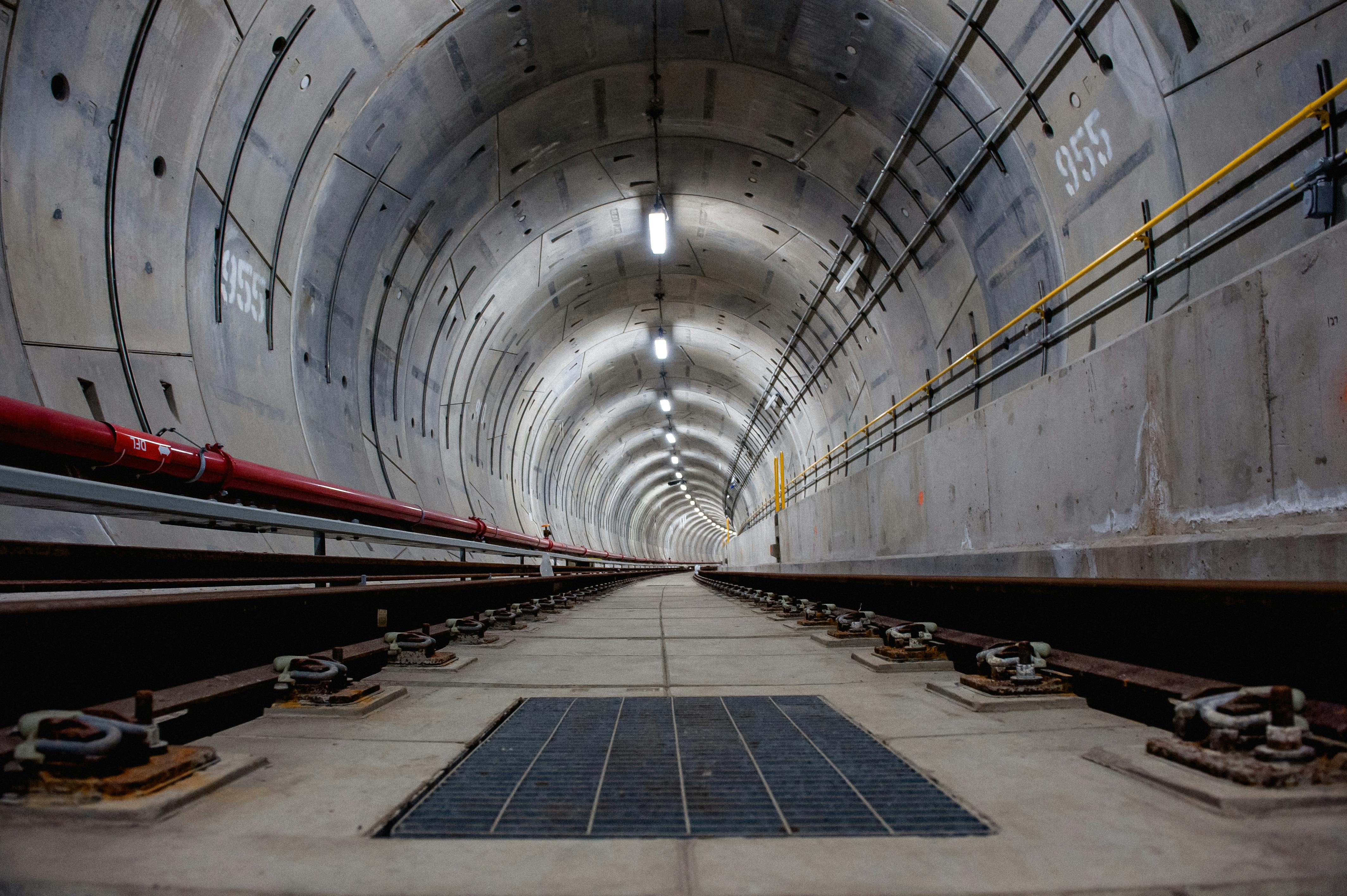
Combining UAV aerial photography with handheld ground data capture, we build a single 3D site model that visualises underground utilities against surface features — a powerful tool for planning, design, and stakeholder communication.
Most site investigations give you either an above-ground survey or an underground utility plan — rarely both in one model. Surface and trench mapping bridges that gap.
We use UAVs (drones) to capture high-resolution aerial imagery of the site surface, then combine it with handheld GPS, total station, and GPR data collected at ground level. The result is a single, georeferenced 3D model showing above-ground features and underground utilities in their true spatial relationship.
This combined visualisation is invaluable for planning decisions, stakeholder presentations, and design — you see how underground services interact with surface features without needing to interpret separate survey and locating reports. For subsurface detection work, see our subsurface utility mapping services.
Four stages from site flyover to a single, georeferenced 3D model.
Our drone captures high-resolution aerial imagery of the site, generating an orthomosaic and 3D surface model.
Handheld GPS, total station, and GPR capture ground-level features, trench profiles, and underground utility data.
Aerial and ground data are combined into a single, georeferenced 3D site model with above and below-ground layers.
You receive the combined model, overlay plans, and visualisations in formats your team can use immediately.
Surface and trench mapping is particularly powerful when you need to communicate site conditions to multiple stakeholders — engineers, project managers, clients, and regulators. A single 3D model does what a stack of separate reports cannot.
By combining aerial and ground-based data, you can see how underground utilities relate to surface features, structures, and proposed works — making design decisions faster and more confident.
Surface and trench mapping combines UAV (drone) aerial photography with handheld ground-based data capture to build a complete 3D model of a site. Above-ground features and underground utility data are combined into a single visualisation, giving project teams a comprehensive view of site conditions for planning, design, and stakeholder communication.
HR Utilities uses UAVs (drones) for aerial photography and photogrammetry, GPS and total stations for ground control and feature capture, GPR for subsurface detection, and laser scanners for detailed 3D point clouds. All equipment is BYDA approved and operated by NULCA-certified technicians.
Standard deliverables include a combined 3D site model showing above-ground features and underground utility positions, orthorectified aerial imagery, 3D point clouds, CAD and GIS overlay plans, and PDF visualisations. Specific formats can be tailored to your project's requirements. Contact HR Utilities to discuss your needs.
Surface and trench mapping is particularly valuable for civil earthworks projects, mining operations, trench verification and as-built documentation, and any project where a comprehensive above-and-below-ground picture is needed for planning or stakeholder presentations. It bridges the gap between a basic survey and a full subsurface investigation.
Expert utility locating services with BYDA certified precision.
Serving projects across Australia with advanced subsurface mapping solutions.