
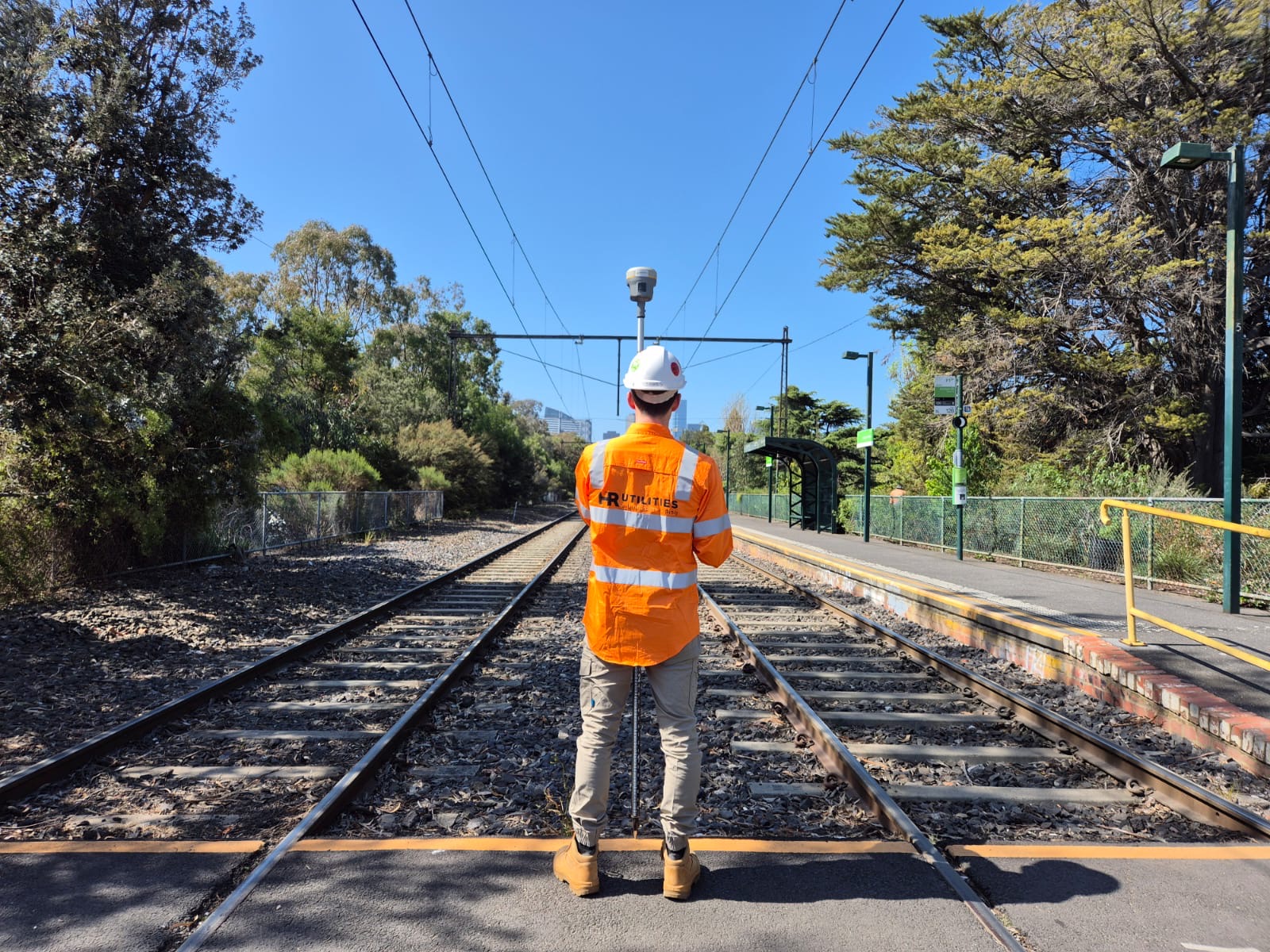
Modern PE and nylon gas mains are invisible to standard electromagnetic locators. HR Utilities uses tracer-wire detection and non-destructive digging to locate gas distribution networks across Melbourne and Victoria — to Energy Safe Victoria requirements.
The gas distribution networks installed across Melbourne and regional Victoria over the past three decades are predominantly polyethylene (PE) or nylon — not steel or cast iron. That distinction is critical: PE and nylon are non-conductive, so the electromagnetic induction method that reliably traces metallic pipes simply does not work on them.
The solution is tracer-wire detection. A conductive wire is buried alongside the PE main at the time of installation; when energised at the surface, it can be traced and marked the same way as a metallic pipe. Where tracer wire is absent, cut, or corroded — which is not uncommon in older networks — non-destructive digging is the only reliable way to establish where the main runs.
There is a further complication: gas services connecting premises to the distribution main are frequently absent from Before You Dig Australia (BYDA) plans. The standard industry position is to assume a gas service is present and treat the area accordingly until the ground is proved clear. Our locating process is built around that assumption.
Gas is a hazardous service. Victorian law sets specific obligations for anyone working near gas infrastructure — before, during, and after excavation.
Non-conductive — not detectable by electromagnetic induction. Tracer-wire detection or non-destructive digging required.
Steel and cast-iron distribution mains are electromagnetically traceable. Depth estimation via signal-strength analysis.
Energised conductive wire traced and GPS-positioned to ±300 mm lateral (QL-B). Compatible with most field locating equipment.
Where tracer wire is inaccessible or QL-A physical exposure is required, hydrovac or air-knife potholing safely exposes the main.
ESV is the Victorian gas safety regulator. Gas strikes are notifiable. Spotter registration may be required for ground disturbance >300 mm near gas assets.
From 16 May 2024, any gas strike site must be preserved for investigation — excavation in the vicinity must stop and the scene secured until authorised.
Under the WorkSafe Victoria and Energy Safe Victoria Guide to Undertaking Work Near Underground Services (Dec 2022), standard gas distribution mains follow the general service clearances: no plant within 500 mm of a located service; hand-digging with care required within that zone; no persons within 300 mm.
For high-voltage electrical cables and major transmission pipelines, a No-Go Zone of 3,000 mm applies — no machinery or plant may operate within this exclusion zone. See our No-Go Zones page for the full clearance table.
A gas strike is a life-safety emergency. If you suspect you have damaged or exposed a gas main, follow these steps immediately:
Gas strikes in Victoria are notifiable events under Energy Safe Victoria regulations. Your principal contractor and site safety officer must also be notified without delay.
A four-stage process from records review to a deliverable you can excavate against.
We lodge a Before You Dig Australia enquiry and compile all available gas network plans, easement data, and site history to establish what is expected underground — and what may be missing from the records.
Our NULCA-certified locators energise the tracer wire installed alongside PE/nylon gas mains and trace its route to surface, marking the pipe position with survey-grade GPS.
Where tracer wire is absent, cut, or inaccessible — or where QL-A physical confirmation is required — we use vacuum excavation to safely expose the main without mechanical force.
The confirmed gas main position is delivered as a CAD plan, GIS file, or PDF overlay georeferenced to MGA and AHD, with AS5488 quality level attributed to each detected feature.
Any ground disturbance within or near a gas easement or known service area requires a BYDA enquiry and, where plans are indicative or absent, field locating before plant moves in. The utility locating process escalates from QL-D (BYDA plans) to QL-B (field-detected and marked) to QL-A (physically exposed) depending on the risk profile of the excavation.
Gas services to individual properties — the pipes connecting a house or business to the distribution main — are a particular risk. These are frequently omitted from BYDA plans, which show the distribution network but not every service connection. The industry standard is to assume a gas service is present in any residential or commercial streetscape until the ground is proved clear.
For assets not shown on any available plan, our underground services not on plans investigation process applies — a combination of GPR, tracer-wire scanning, and targeted non-destructive digging to establish what is actually in the ground.
Yes — but not with a standard electromagnetic locator. Modern polyethylene (PE) and nylon gas mains are non-conductive, so electromagnetic induction methods that work on metallic pipes cannot detect them directly. Our primary approach is tracer-wire detection: a conductive wire installed alongside the PE pipe during construction is energised and traced to the surface. Where tracer wire is absent, cut off, or inaccessible, we use non-destructive digging (vacuum excavation) to safely expose and confirm the pipe position.
Tracer wire (also called locating wire or marker wire) is a conductive wire buried alongside a non-metallic pipe — typically PE gas mains — at the time of installation. It allows electromagnetic locating equipment to trace the route of an otherwise undetectable pipe. If the tracer wire has been cut, corroded, or was never installed (common in older networks), the pipe cannot be electromagnetically traced, and non-destructive digging becomes the only reliable method to establish its position.
Under the WorkSafe Victoria and Energy Safe Victoria Guide to Undertaking Work Near Underground Services (Dec 2022), standard gas distribution mains follow the general service clearances: machinery must not operate within 500 mm of a located service, no persons within 300 mm, and hand-digging with care is required within 500 mm. For high-voltage electrical services and major transmission pipelines, a No-Go Zone of 3,000 mm applies — no plant or machinery can operate within this exclusion zone without specific authority. Always establish the utility type and pressure rating before work begins.
If you strike or damage a gas main: stop all work immediately; remove all ignition sources (no mobile phones, engines, or electrical equipment near the escape); evacuate the area and keep bystanders clear; call your gas distributor's 24-hour emergency line and call 000 if there is immediate danger. Do not attempt to repair or contain the leak yourself. Gas strikes in Victoria are notifiable events under Energy Safe Victoria regulations, and from 16 May 2024 a site-preservation duty applies — the scene must be preserved for investigation.
Yes. A BYDA enquiry is a mandatory first step before any ground disturbance and must be completed regardless of whether you engage a locating service. However, BYDA plans are explicitly 'indicative only' and typically represent quality level D (QL-D) under AS5488 — they show approximate routes based on network records, not verified field positions. Gas services to individual premises are frequently absent from BYDA plans entirely. Our locating work upgrades the BYDA baseline to a verified field position (QL-B or QL-A) that is safe to excavate against.
Expert utility locating services with BYDA certified precision.
Serving projects across Australia with advanced subsurface mapping solutions.