
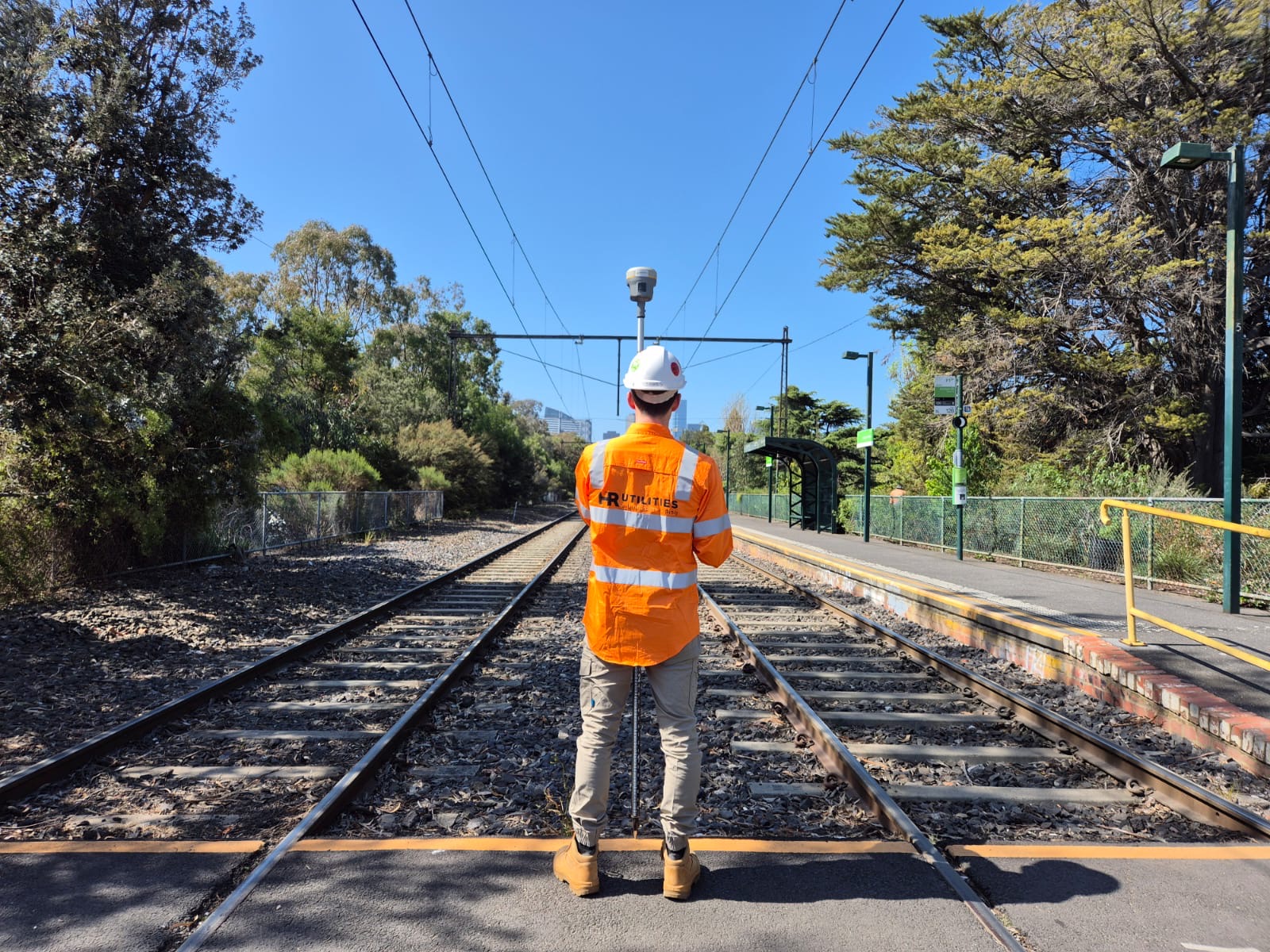
Victorian law requires every person conducting excavation to positively locate underground services before plant moves. The WorkSafe Victoria and Energy Safe Victoria Guide sets defined No-Go Zone distances — and accurate locating is the control that lets safe work proceed.
The Occupational Health and Safety Act 2004 (Vic) requires a person conducting a business or undertaking (PCBU) to eliminate or reduce risks so far as reasonably practicable before commencing work. For excavation, that means identifying the location of every underground service that could be struck.
The WorkSafe Victoria and Energy Safe Victoria Guide to Undertaking Work Near Underground Services (December 2022) translates that duty into a practical sequence: lodge a Before You Dig Australia enquiry to obtain available records, then actively locate services on site using electromagnetic detection, ground penetrating radar, or non-destructive digging to confirm position and depth.
BYDA plans are a starting point only. Asset owners themselves state that plans are indicative — they may be out of date, exclude private services, and do not show depth. Positive locating on the ground is where duty of care is actually discharged.
The December 2022 guide sets two distance regimes — one for standard distribution services and one for high-voltage transmission cables and major pipelines.
All distances measured from the located (confirmed) service centreline. Where position is uncertain, the worst-case assumed location governs.
Electricity distribution cables, gas distribution mains, water mains, telecommunications
Mechanical plant may operate without a spotter. No restrictions on personnel.
Mechanical plant may operate only with a registered spotter maintaining line-of-sight. Personnel present.
No mechanical plant. Hand digging permitted with great care. Spotter required.
No personnel at all until the service is fully exposed and confirmed safe.
Transmission cables, high-pressure gas transmission pipelines
Mechanical plant may operate without a spotter. No additional restrictions.
Mechanical plant requires a registered spotter (UGM class, Energy Safe Victoria) at all times.
No mechanical plant. Hand digging with great care only. No persons until service is fully exposed and confirmed.
Hand digging with great care is permitted within the No-Go Zone of any service type once the service has been positively located and is visible.
A structured sequence aligned with the OHS Act 2004 (Vic) duty and the WorkSafe Victoria / Energy Safe Victoria Guide.
Before any ground disturbance, lodge a Before You Dig Australia enquiry to obtain available plans and asset-owner records for the site. Plans are indicative only — they are a starting point, not a substitute for active locating.
Use electromagnetic induction, ground penetrating radar, and where necessary non-destructive digging to confirm the position and depth of services to an accuracy appropriate for the planned work. This is the OHS Act 2004 (Vic) duty to identify hazards before commencing.
Based on confirmed service positions, set the correct No-Go Zone distances per the WorkSafe Victoria / Energy Safe Victoria Guide (December 2022). Where position remains uncertain, treat the worst-case assumption as the service location.
If work is planned within the spotter zone of a high-voltage cable or major pipeline, engage an Energy Safe Victoria registered spotter (UGM class) before plant enters the zone. The spotter must maintain line-of-sight with the service and direct the plant operator throughout.
Energy Safe Victoria requires a registered spotter whenever ground disturbance deeper than 300 mm takes place within the spotter zone of a high-voltage cable or major pipeline. The relevant class is UGM — Underground Services, Mechanical Disturbance.
UGM registration requires completion of a structured training program delivered by a Registered Training Organisation plus a current first aid certificate. ESV issues the registration directly. Spotters must maintain an unobstructed line of sight between plant and the located service at all times, and must direct the plant operator to halt immediately if any discrepancy — unexpected depth, changed alignment, unexpected material — is observed.
A spotter is not a substitute for accurate locating. The spotter's ability to perform their function depends entirely on having a confirmed, marked service position to reference. Where gas main locating or other active detection has not established the service position, the spotter has nothing reliable to sight on.
No-Go Zone distances are measured from the located service. An uncertain position means an expanded zone — in practice, a larger exclusion area that restricts what machinery can do and where.
Accurate utility locating using electromagnetic induction, ground penetrating radar, and non-destructive digging to achieve QL-A physical exposure is the engineering control that collapses the zone of uncertainty to within ±50 mm. That precision is what allows plant to operate at the distances specified in the guide rather than at a precautionary multiple of those distances.
Where services are absent from available plans — a common finding on older urban sites — the locating process is what identifies them in the first place. Services cannot be managed using No-Go Zones if their existence is unknown. See also our utility locating services for the full range of detection methods available.
A No-Go Zone is a defined exclusion area around a known or suspected underground service within which certain activities — mechanical excavation, unsupported hand digging, or the presence of personnel — are prohibited without additional controls. The WorkSafe Victoria and Energy Safe Victoria Guide to Undertaking Work Near Underground Services (December 2022) sets the inner No-Go Zone at 300 mm from standard services (no persons) and 500 mm (no machinery), and at 3,000 mm from high-voltage cables or major pipelines. These distances apply once a service has been positively located; if the service position is uncertain, the zone must be expanded accordingly.
Under the WorkSafe Victoria and Energy Safe Victoria Guide (December 2022), standard services (electricity distribution, gas distribution mains, water, and telecommunications) require: open mechanical work permitted beyond 2,000 mm; a spotter required between 500 mm and 2,000 mm; no plant or machinery within 500 mm; and no persons within 300 mm. High-voltage transmission cables and major pipelines carry wider distances: open work beyond 4,500 mm; spotter required between 3,000 mm and 4,500 mm; No-Go Zone within 3,000 mm. Hand digging is permitted within a No-Go Zone but must be carried out with great care.
Energy Safe Victoria requires a registered spotter whenever ground disturbance deeper than 300 mm occurs within the spotter zone of a high-voltage or major pipeline service. The relevant registration class is UGM (Underground Services — Mechanical Disturbance). Spotters must hold registration issued by Energy Safe Victoria, which requires completion of RTO-delivered training and a valid first aid certificate. The spotter's role is to maintain a direct line of sight between plant and the located service, direct the operator, and halt work immediately if any discrepancy is detected.
No-Go Zones can only be correctly set once a service is positively located. The OHS Act 2004 (Vic) requires a person conducting a business or undertaking to identify hazards before commencing work; for underground services, this means lodging a Before You Dig Australia enquiry and then using electromagnetic locating, ground penetrating radar, or non-destructive digging to establish the service position with sufficient confidence for the work at hand. Accurate locating reduces the zone of uncertainty, allows safe planning, and is the primary engineering control that enables mechanical excavation to proceed as close as the regulations allow.
Yes, subject to clearance distances and controls. For standard services, mechanical plant may operate beyond 500 mm from the located service — provided a registered spotter is present between 500 mm and 2,000 mm. Within 500 mm, only hand digging with great care is permitted. For high-voltage cables and major pipelines, the no-machinery zone is 3,000 mm; a spotter is required between 3,000 mm and 4,500 mm. These distances assume the service has been positively located. Where location is uncertain, the assumed position is the worst-case scenario and the zone must be expanded. Non-destructive digging is the standard method for establishing a confirmed service position before plant approaches.
Expert utility locating services with BYDA certified precision.
Serving projects across Australia with advanced subsurface mapping solutions.