
What Melbourne Project Teams Should Expect From Underground Utility Locating After BYDA
Published on 7/21/2026 by HR Utilities
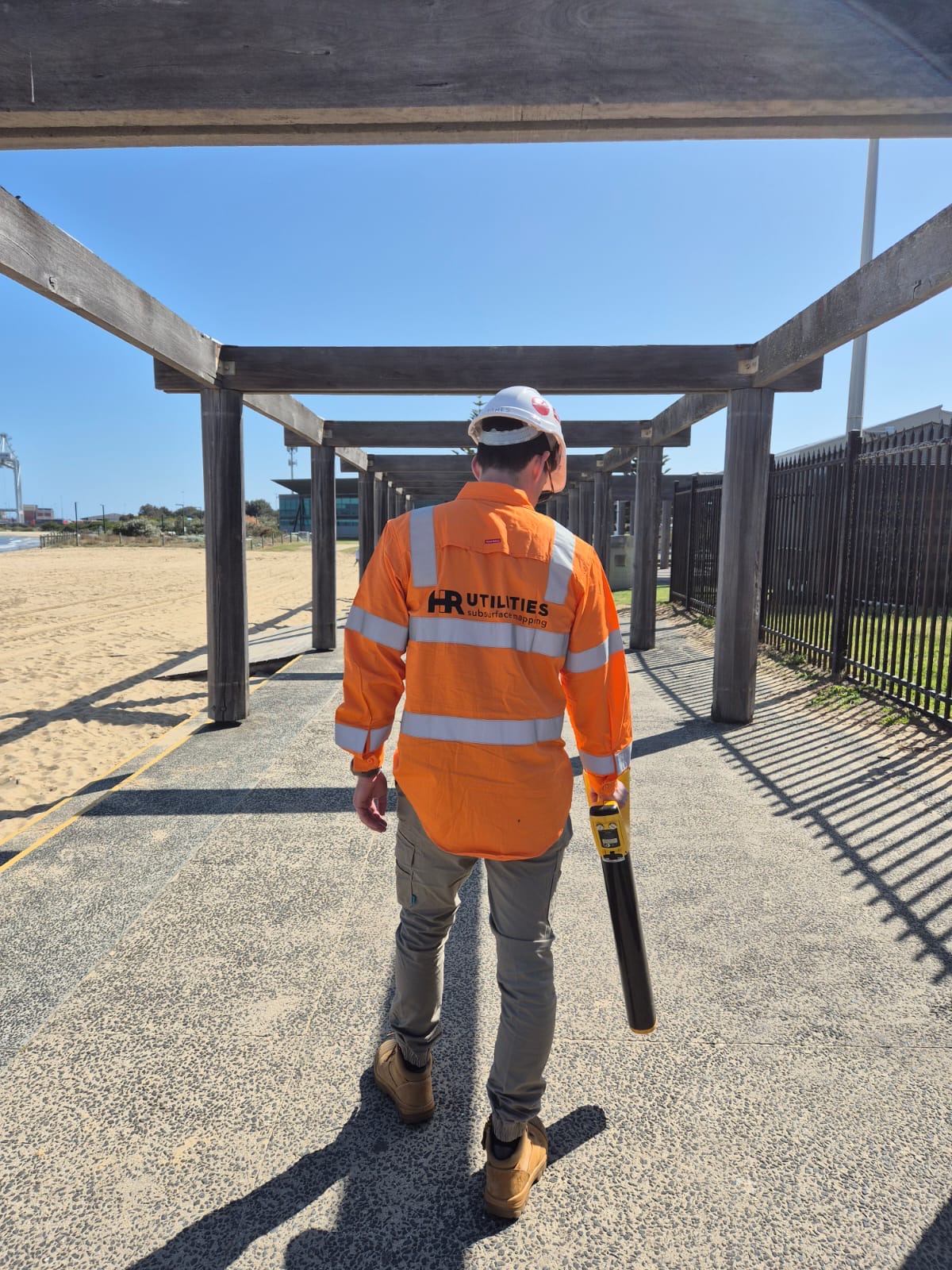
The diggers are booked for Monday. You hold a folder of utility plans from the referral, and nothing on those sheets puts paint on the ground. Depth is blank. The domestic run that leaves the meter never appears. Plant will arrive expecting marks. Leave that gap and you lose a day to standing plant, or open a trench on an unmarked service.
You lodged that pack through Before You Dig Australia (BYDA), the national referral that asks asset owners for plans of registered infrastructure in your search area. BYDA states those plans support planning and are indicative [1]. Under AS 5488.1:2022 (the Australian standard for subsurface utility information), that records baseline is Quality Level D [2]. Quality Level D starts the file. Locators verify on site with electromagnetic methods and ground-penetrating radar (GPR), then prove where clash risk is high, so crews get marks and survey data they can work to.
This briefing is for project managers, estimators, and site engineers running enabling works across metropolitan Melbourne. Claims stay with primary sources: BYDA, AS 5488.1:2022, Safe Work Australia, WorkSafe Victoria, Energy Safe Victoria, and Melbourne Water. National strike-cost numbers live in the companion article listed under Further reading.
What “after BYDA” means on a Melbourne job
Lodging a BYDA enquiry is the referral step. Asset owners return plans for registered infrastructure in the search area. BYDA calls those plans indicative [1]. Depth stays unconfirmed. Completeness is not guaranteed. Private and domestic connections that leave the network at the property boundary sit outside the pack — the gap covered in detail in private vs public utilities and the BYDA gap.
Quality Level D under AS 5488.1:2022 is that records baseline [2]. Melbourne’s mix of Victorian-era streets, post-war suburbs, and dense CBD corridors puts many services off the drawing or at depths the PDF never states. After BYDA you hold a document set to brief the locator. Mechanical excavation needs field verification.
Plans versus locating: what each answers
| Question | BYDA plans (QL-D) | Field locating (QL-B / QL-A) |
|---|---|---|
| Which asset owners responded? | Yes | Uses that list as input |
| Approximate horizontal route? | From records, where drawings exist | Verified or corrected on site |
| Depth? | Unreliable from records alone | Inferred at QL-B; verified at QL-A |
| Private / domestic services? | Absent from many packs | Assumed present until cleared |
| Dig marks for plant? | No | Paint, pegs, and briefings |
Melbourne locators start from the BYDA pack, then apply electromagnetic locating (EML) on metallic and tracer-wired assets and GPR where plastics and concrete drains dominate. They survey detections and attribute features toward AS 5488 Quality Level B (±300 mm horizontal / ±500 mm vertical under the standard’s geophysical tier) [2].
Crews reach Quality Level A (±50 mm) by non-destructive digging (vacuum excavation / potholing) [2]. Seeing the asset confirms depth.
How to sequence the work (QL-D → QL-B → QL-A)
Treat quality levels as a ladder tied to project risk. Escalate where the design needs verified position [2].
- Complete BYDA and read the pack for gaps. Note aged drawings, gaps between asset owners, and corridors with no response. Assume services may exist where records are silent, including older Melbourne streets and private property [1].
- Commission corridor locating to QL-B. Scope EML and GPR across the works footprint. Ask for AS 5488 attribution on each feature so the drawing shows what was detected versus what remains records-only [2].
- Identify clash points. Overlay the QL-B model on design: piles, footings, HDD paths, trench alignments, and crane pads.
- Prove at clashes to QL-A. Book vacuum excavation where design decisions or plant clearances depend on verified position. Tie survey to MGA / AHD so the prove feeds CAD and GIS [2]. Near Melbourne Water assets or easements, physical proving and licensed survey to that authority’s utility installation standard is a common consent gate [7].
- Brief plant on Victorian no-go rules. Locating leaves clearance distances intact. WorkSafe Victoria and Energy Safe Victoria’s Guide to Undertaking Work Near Underground Services (December 2022) governs how close machinery and people may approach located services [4].
Run this sequence early enough that drawings and prices can change. That is the pre-tender utility investigation window.
Objections Melbourne teams raise, with source answers
“Our BYDA came back clear.”
An empty response covers registered assets only. Registration coverage varies by jurisdiction and asset class. BYDA plans remain indicative; private services and unregistered laterals sit outside the pack [1] — see what BYDA doesn’t cover on Australian sites. The Safe Work Australia Model Code of Practice: Excavation Work (October 2022) requires location and depth to be established where underground services may be present and uncertain [3].
“We’ve dug here before without a strike.”
A previous trench without a strike does not certify the next alignment 400 mm away. Owners abandon, relocate, and overlay services over time.
“Just pothole everything to QL-A.”
QL-A across the full footprint burns budget without matching risk reduction. Follow AS 5488 staged escalation: QL-B across the corridor, QL-A where the design depends on verified depth [2]. BYDA’s November 2024 economic assessment of national strike costs supports targeted proving over blanket daylighting of every metre [5].
“Locating is the principal’s problem / the contractor’s problem.”
Victorian OHS duties around underground essential services sit with the controller of the work [3][4]. Contract silence leaves those duties in place. Under AS 4000 latent-condition mechanics, both principals and contractors carry commercial exposure when tender information is only QL-D. Commission attributed locating and you shrink that gap.
Best practice for Melbourne sites
Melbourne enabling works hit the same pressure points:
- Non-conductive networks. PVC and HDPE water and sewer mains, PE gas without a usable tracer wire, and concrete stormwater drains stay invisible on EML alone. Budget GPR time and proving into those scopes.
- Stacked CBD and inner-suburban corridors. Multiple owners share narrow footpaths. Expect more marks than the plan count, and allow for traffic management that keeps paint readable for the night shift.
- No-go zone discipline after the locate. Once services are marked, plant must honour WorkSafe VIC / ESV clearances (including wider distances for high-voltage and major pipelines). Spotter requirements apply inside the intermediate zones, and Energy Safe Victoria’s spotter registration covers underground mechanical (UGM) classes for ground disturbance work in those bands [4][6].
- Timing. Run BYDA → QL-B → selective QL-A before tender freeze on fixed-price or design-critical jobs. Find a clash during excavation and you pay for standing plant and redesign.
What to put in the purchase order
Ask for deliverables a superintendent can audit:
- BYDA enquiry reference and plan set used
- Methods applied (EML, GPR, vacuum excavation)
- AS 5488 quality level attributed per feature
- Site marks plus survey file (CAD / GIS) on MGA / AHD where survey is in scope
- Photographs and depths at any QL-A proves
- Written note of limitations (areas not accessible, signal interference)
Utility locating after BYDA should deliver that package: a field-verified dataset with known confidence. Another unread PDF folder leaves the diggers without marks.
Frequently asked questions
Does a BYDA enquiry satisfy excavation due diligence in Victoria?
It satisfies the referral step. On its own it does not establish location and depth for mechanical excavation where services may be present [1][3]. Combine BYDA with field locating matched to the risk, and follow WorkSafe Victoria / Energy Safe Victoria no-go guidance around located assets [4].
How long after BYDA should we book locators?
Book as soon as the works footprint is stable enough to walk. Plans can expire or fall out of date relative to other works in the corridor. Leave a short gap between the enquiry and the field visit on active Melbourne sites.
When is non-destructive digging required?
Book non-destructive digging when AS 5488 QL-A is needed (at confirmed design clashes) or when plant must approach inside distances where position must be proven before mechanical excavation [2][4]. Safe Work Australia’s excavation code expects physical proving where location remains uncertain and risk warrants it [3]. Melbourne Water consent near drains or easements needs the same physical prove, surveyed to MGA Zone 55 and AHD [7].
Can one locate cover water, gas, power, and telco?
A competent Melbourne locate scopes all expected asset classes. Method mix changes by material: EML for conductive / tracer-wired services; GPR and proving for many water, stormwater, and PE gas assets.
What quality level should tender documents specify?
State the minimum quality level required for construction decisions (QL-B across the corridor with QL-A at nominated clash points is common) [2]. Unmarked QL-D plans leave excavation without verified position.
Sources
[1] Before You Dig Australia (BYDA) - FAQs and indicative-plans guidance. https://www.byda.com.au/faqs/ [2] Standards Australia - AS 5488.1:2022 Classification of subsurface utility information (Part 1). https://store.standards.org.au/product/as-5488-1-2022 [3] Safe Work Australia - Model Code of Practice: Excavation Work (October 2022). https://www.safeworkaustralia.gov.au/doc/model-code-practice-excavation-work [4] WorkSafe Victoria and Energy Safe Victoria - Guide to Undertaking Work Near Underground Services (December 2022). https://www.worksafe.vic.gov.au/resources/guide-undertaking-work-near-underground-services [5] Before You Dig Australia - Economic Assessment of Utility Strikes in Australia (November 2024). https://www.byda.com.au/2024/11/28/utility-strikes-cost-australia-5-billion-annually/ [6] Energy Safe Victoria - Spotter registration (underground mechanical / UGM). https://www.energysafe.vic.gov.au/licensing/electrical-licences/licence-types/spotters-registration [7] Melbourne Water - Utility installation guidelines (work near assets or easements; prove the asset location). https://www.melbournewater.com.au/building-and-works/work-or-build-near-our-assets-or-easements/utility-installation-guidelines
Further reading
- What a Utility Strike Really Costs in Australia
- Private vs Public Utilities: What BYDA Doesn’t Cover on Australian Sites
- Utility Locating Before Excavation: A Practical Checklist for Australian Sites
HR Utilities provides BYDA-aware underground utility locating, AS5488 investigations, and non-destructive digging across Melbourne and regional Victoria. Contact the team to scope locating for your next enabling-works window.
Related services: